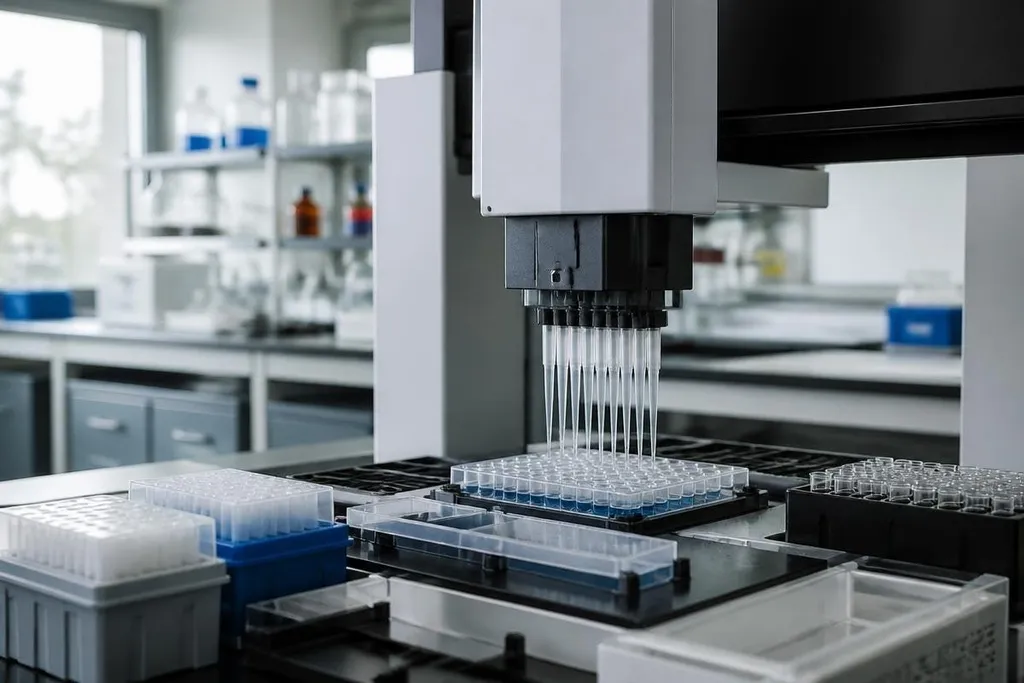
A laboratory robot can repeat the same pipetting step across a 96-well plate without tiring or changing its grip. That matters because many experiments depend on running hundreds of small tests before a useful result appears.
For a research team, the gain comes from steady repeat work, faster sample handling, and cleaner records. The robot doesn't replace the scientist who chooses the question. It handles more of the path between that question and the next result.
Quick read
- Robots can move plates, pipette liquid, read barcodes, and record results.
- Automation helps most when a lab repeats the same steps across many samples.
- Poor protocols, weak checks, and slow analysis can still hold back a project.
What the robot actually does
Most laboratory robots work as part of a wider system. A liquid-handling arm moves tips over tubes or wells, adds measured liquid, and sends the plate to another station.
A reader may then measure color, light, cell growth, or another test signal. The useful unit is the full process, not the arm alone.
A robot may need a gripper, tip racks, waste bins, plate storage, sensors, and software that records which sample went where. If one station stops, the whole run can wait for a person to fix it.
Barcode tracking gives each tube or plate a record. That record can hold the sample name, the liquid added, the time of the step, and the result from the reader. A clear log makes it easier to find where a failed experiment went wrong.
Where the time savings come from
A person may spend a large part of a workday moving plates, changing pipette tips, or setting up repeat tests. A robot can run those steps during a longer window, including periods when no scientist is standing beside the instrument.
That extra run time only helps when the process is ready. The lab still needs a tested method, enough reagents, clean samples, and a way to check that the robot handled each step correctly. Automation repeats a good process well, but it can repeat a bad process at the same speed.
Robots also make some test plans easier to expand. A scientist can set different liquid amounts across a plate, test several temperatures, or compare many sample groups in one run. The result is a larger set of measurements from the same setup, which can help the team choose the next experiment sooner.
A scientist comparing lab automation can use Robot24.com's robotics coverage to check the task, test date, and human input behind each result. Those details matter before the next section looks at the limits that can slow a project.
The limits that slow projects down
Laboratory work is rarely as tidy as a diagram. Liquids can foam, clog a tip, stick to plastic, or settle at different rates. A gripper can miss a plate, a sensor can fail to read a label, and a software error can send a sample to the wrong station.
The robot also needs a way to spot problems. Cameras, liquid-level checks, weight checks, and barcode scans can catch some faults. They can't fix a poor experiment design or decide whether an odd result came from biology, contamination, or a setup error.
Software work can take longer than expected. Each device may use a different control system, file format, or connection method. A team that buys several instruments may spend time making them exchange sample IDs and status data before the full process runs without manual steps.
Cost creates another limit. The price includes the robot, lab changes, service, spare parts, software, training, and staff time for setup. A small lab may get more value from one reliable liquid handler than from a large system that sits idle between projects.
A practical buying checklist
Use these checks before you choose a system:
- Map the full process: Write every step from sample arrival to stored result.
- Count repeat work: Measure plates, tubes, transfers, and manual checks per week.
- Test the materials: Run the robot with the real liquids, tips, tubes, and plates.
- Plan fault recovery: Decide who gets the alert and how they restart a failed run.
- Check data records: Confirm that each sample keeps its ID through every station.
- Price the support: Include service visits, spare parts, software fees, and training.
I'd fund the repeatable steps first, because a smaller system that runs each day can help more than a larger one that needs constant setup.
The next useful measure is the time between a scientist's question and a checked result, with every sample and failed step accounted for.